Pioneer
PIONEER RG-1 Electrolytic Capacitor Set complete recap repair
PIONEER RG-1 Electrolytic Capacitor Set complete recap repair
Couldn't load pickup availability
(see english version below)
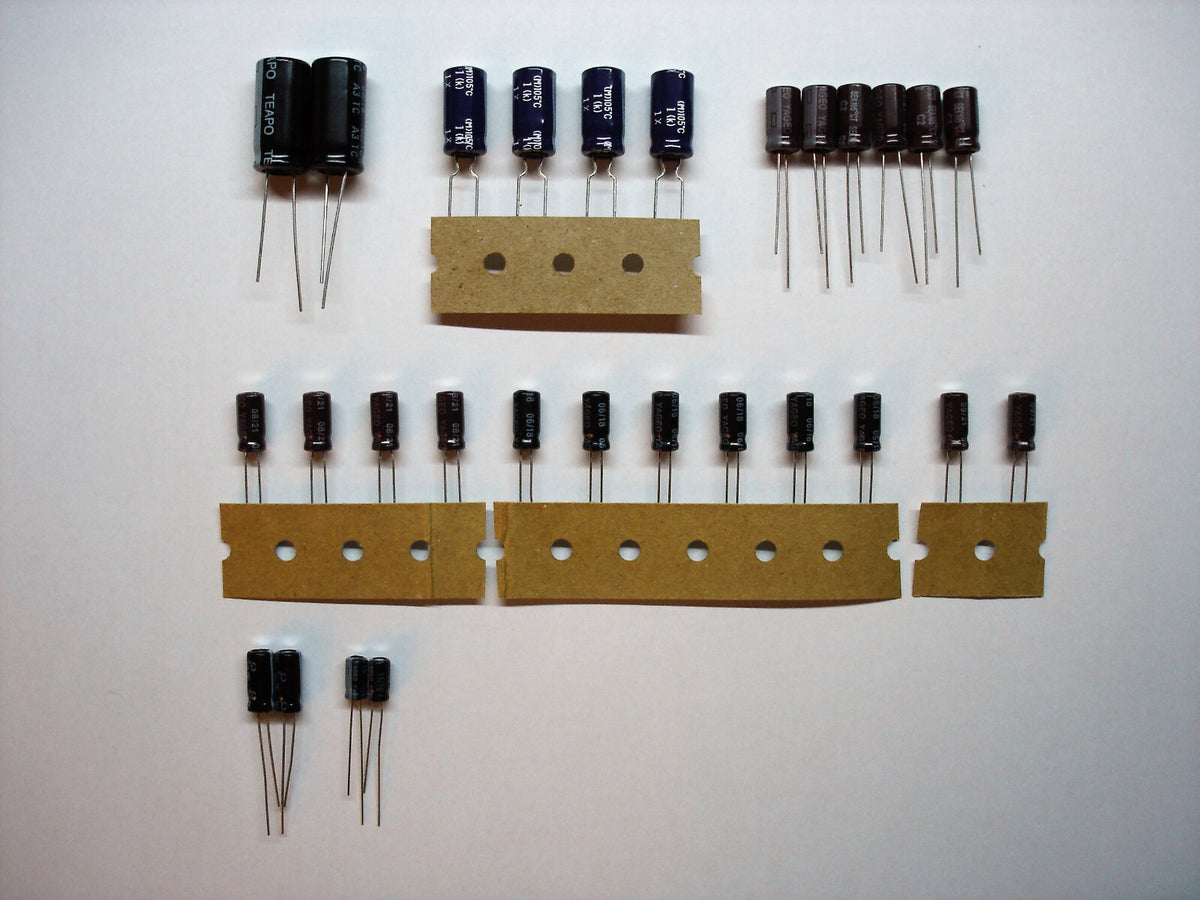
The kit consists of 28 electrolytic capacitors.
Most of the capacitors have been chosen with a higher voltage rating and generally possess higher temperature resistance as well. Both factors have a positive effect on the expected lifespan. Thanks to advances in capacitor manufacturing, they are still a perfect fit.
This kit can also be used as a preventative measure, as problems caused by failed or "worn out" capacitors lead to a loss in sound quality. After all, they are now many years old in some cases and have certainly lost capacity due to drying out or years of use. Using a capacitance meter, I measured a 2200µF capacitor from a Philips 202. Its capacity was only 1551µF. This deterioration continues over time.
Complete recapping kit for all electrolytic caps of the Pioneer Dynamic Processor RG-1
This kit consists of 28 electrolytic aluminium manufactured by best known companys. Most of the caps have larger voltage capability and larger temperature capability which increases lifetime.
Electrolytic aluminium capacitors are made from two aluminium foil strips and one paper strip. The paper is made wet with non conducting fluid
and coiled up between the two aluminium strips. That roll is housed in an aluminium housing and sealed with a rubber plate wich allows the two wire conductors to come out. It is possible that air gets into the two holes in case not good sealed due to oxidation of the wire, hardening of the rubber by aging or too high temperature or too long soldering process with melting the rubber where it contacts the wires. But extreme condition in the power supply like ripple current can make a cap hot and let the fluid damp away. Some caps have a ventilation hole wich opens in case pressure gets to high.
This is not an extreme example but I once had a PHILIPS 2200µF cap wich measured as 1551µF after 32 years. It can be more extreme and it goes on, the older your device gets.
Important notes:
You
should be aware of the dangers of working on opened devices
and only perform the work if you are a qualified person, or have it performed
by a qualified person, as there is a risk of
electric shock as long as the power plug is inserted.
Installing
the capacitors in this kit requires skills in soldering on circuit boards.
If
you are in doubt about your own soldering skills, please contact
someone who is familiar with it, e.g., a professional, and
do not use your classic device to learn soldering; it might have a hard time surviving that.
Attention: electrolytic capacitors must be installed with the correct polarity,
i.e. they have a plus (+) and a minus (-) pole. On an electrolytic capacitor with
liquid electrolyte, the negative pole is always marked,
either by the imprint on the side or the shorter leg in the case of new capacitors. It is recommended to take detailed photos of the previous state
and/or to mark all negative poles with a small
dot (permanent marker) on the board before desoldering. The silk-screen markings do not always correspond to reality.
Our offer relates only to the replacement part kit, which can be purchased in brand-new quality.
We offer a 30-day right of withdrawal.
If your desired capacitor kit contains these values, they will now be replaced by KEMET R82 series film capacitors, which are very well suited for hi-fi applications. Furthermore, for the same reason, once existing stock is depleted, WIMA MKS film capacitors with the values 2.2µF and 3.3µF will be replaced by the excellent PANASONIC EB-A series electrolytic capacitors.
Manufacturer Part Number: N/A
Brand: Pioneer
Model: RG-1
Product Type: Electrolytic Capacitor Kit
Country of Origin: Germany
Christoph Mistler
An der Kull 51
DE-41844 Wegberg
Email: info@80s-hifi-classics.com
Product Documents:
INSTALLATION_INSTRUCTIONS:
DE,EN,ES,FR,IT,NL,PL,PT.pdf
Hazard statements
Hazard statements
Informationen zur Produktsicherheit
- Bitte außerhalb der Reichweite von Kindern aufbewahren!
- Enthält Kleinteile, Erstickungsgefahr!
- Elkos enthalten möglicherweise giftiges Elektrolyt!
Vergiftungsgefahr!
- Polung muss beachtet werden!
- bei ausgestecktem Gerät und Spannungsfrei arbeiten
- Kondensatoren können auch nach längerem Nicht-Betrieb noch
lebensgefährliche Spannungen gespeichert haben!
Information on product safety
- Please keep out of the reach of children!
- Contains small parts, risk of suffocation!
- Electrolytic capacitors may contain toxic electrolyte!
Risk of poisoning!
- Polarity must be observed!
- Work with the device unplugged and de-energized
- Capacitors may still store life-threatening voltages even after a long period of disuse!
Informations sur la sécurité des produits
- Veuillez tenir hors de portée des enfants !
- Contient de petites pièces, risque d'étouffement !
- Les condensateurs électrolytiques peuvent contenir un
électrolyte toxique ! Risque d'intoxication !
- La polarité doit être respectée !
- Travaillez avec l'appareil débranché et hors tension
- Les condensateurs peuvent encore accumuler des tensions
dangereuses même après une longue période de non-utilisation !
Informazioni sulla sicurezza del prodotto
- Tenere fuori dalla portata dei bambini!
- Contiene piccole parti, rischio di soffocamento!
- I condensatori elettrolitici possono contenere elettrolita
tossico! Rischio di avvelenamento!
- È necessario rispettare la polarità!
- Lavorare con il dispositivo scollegato e senza corrente
- I condensatori possono ancora accumulare tensioni pericolose per la vita anche dopo un lungo periodo di inattività!
Informatie over productveiligheid
- Buiten bereik van kinderen houden!
- Bevat kleine onderdelen, verstikkingsgevaar!
- Elektrolytische condensatoren kunnen giftige elektrolyt
bevatten! Vergiftigingsgevaar!
- Polariteit moet in acht worden genomen!
- Werk met het apparaat losgekoppeld en spanningsloos
- Condensatoren kunnen nog steeds levensbedreigende
spanningen opslaan, zelfs na een lange periode van inactiviteit!
Informacje na temat bezpieczeństwa produktu
- Przechowywać w miejscu niedostępnym dla dzieci!
- Zawiera małe części, ryzyko uduszenia!
- Kondensatory elektrolityczne mogą zawierać toksyczny
elektrolit! Ryzyko zatrucia!
- Należy przestrzegać biegunowości!
- Pracuj z urządzeniem odłączonym od zasilania i pozbawionym
zasilania
- Kondensatory mogą nadal gromadzić napięcia zagrażające
życiu nawet po długim okresie nieużywania!
Informações sobre a segurança do produto
- Por favor, mantenha fora do alcance das crianças!
- Contém peças pequenas, risco de asfixia!
- Os condensadores electrolíticos podem conter electrólito
tóxico! Risco de envenenamento!
- A polaridade deve ser observada!
- Trabalhar com o dispositivo desligado e desenergizado
- Os condensadores podem ainda armazenar tensões
potencialmente fatais mesmo após um longo período sem utilização!
Información sobre la seguridad del producto
- ¡Manténgase fuera del alcance de los niños!
- Contiene piezas pequeñas, ¡riesgo de asfixia!
- ¡Los condensadores electrolíticos pueden contener
electrolito tóxico! ¡Riesgo de intoxicación!
- ¡Se debe respetar la polaridad!
- Trabaje con el dispositivo desenchufado y sin corriente-
Los condensadores pueden seguir almacenando voltajes potencialmente mortales
incluso después de un largo período de inactividad.
Assembly instructions
Assembly instructions
Installation and Assembly Instructions
This type-specific capacitor kit is intended to replace the
electrolytic capacitors in the respective device, either because the existing
capacitors are defective or because those we offer are superior to the
originally installed ones (upgrade).
1. First, it is advisable to take many photos: of the
wiring, the circuit board, and the capacitors. Since electrolytic capacitors
are mostly polarized (they have a positive and a negative lead or side), it is
helpful to be able to refer to these photos to ensure the correct orientation
when installing the new capacitor (in some cases, you cannot trust the circuit
board markings, if any).
2. Next, assess the situation. Keep in mind that in the vast
majority of cases, the new capacitors have a higher voltage rating 1.
3. Proceed step-by-step: desolder a defective capacitor 2, then solder in a new one.
1 The value of the maximum permissible voltage (V) may match
that of the old capacitor, but it may very well be higher and must NEVER be
lower.
An example:
Your device contains four different types of 47µF capacitors:
47µF/10V, 47µF/25V,
47µF/35V and
47µF/50V.
We would supply you with the following replacement types:
2x 47µF/35V as a replacement for 10V and 25V
2x 47µF/63V as a replacement for 35V and 50V.
Although the original includes a 35V capacitor, a 63V
capacitor is supplied to increase the voltage rating.
2 In individual cases, we recommend desoldering with the help
of desoldering braid and a manual desoldering suction pump. The best option
would be an electronic desoldering station with a heated suction gun, but its
acquisition is usually not worthwhile for smaller projects.
Manufacturer
Manufacturer
Pioneer
Teilen