Bang & Olufsen
B&O Beogram CD 5500 6500 7000 Elektrolyt-Kondensator-Set COMPLETE recap repair
B&O Beogram CD 5500 6500 7000 Elektrolyt-Kondensator-Set COMPLETE recap repair
Verfügbarkeit für Abholungen konnte nicht geladen werden
Kompletter Elko-Satz für alle Platinen des Bang und Olufsen Beogram CD 5500, CD6500 und CD7000
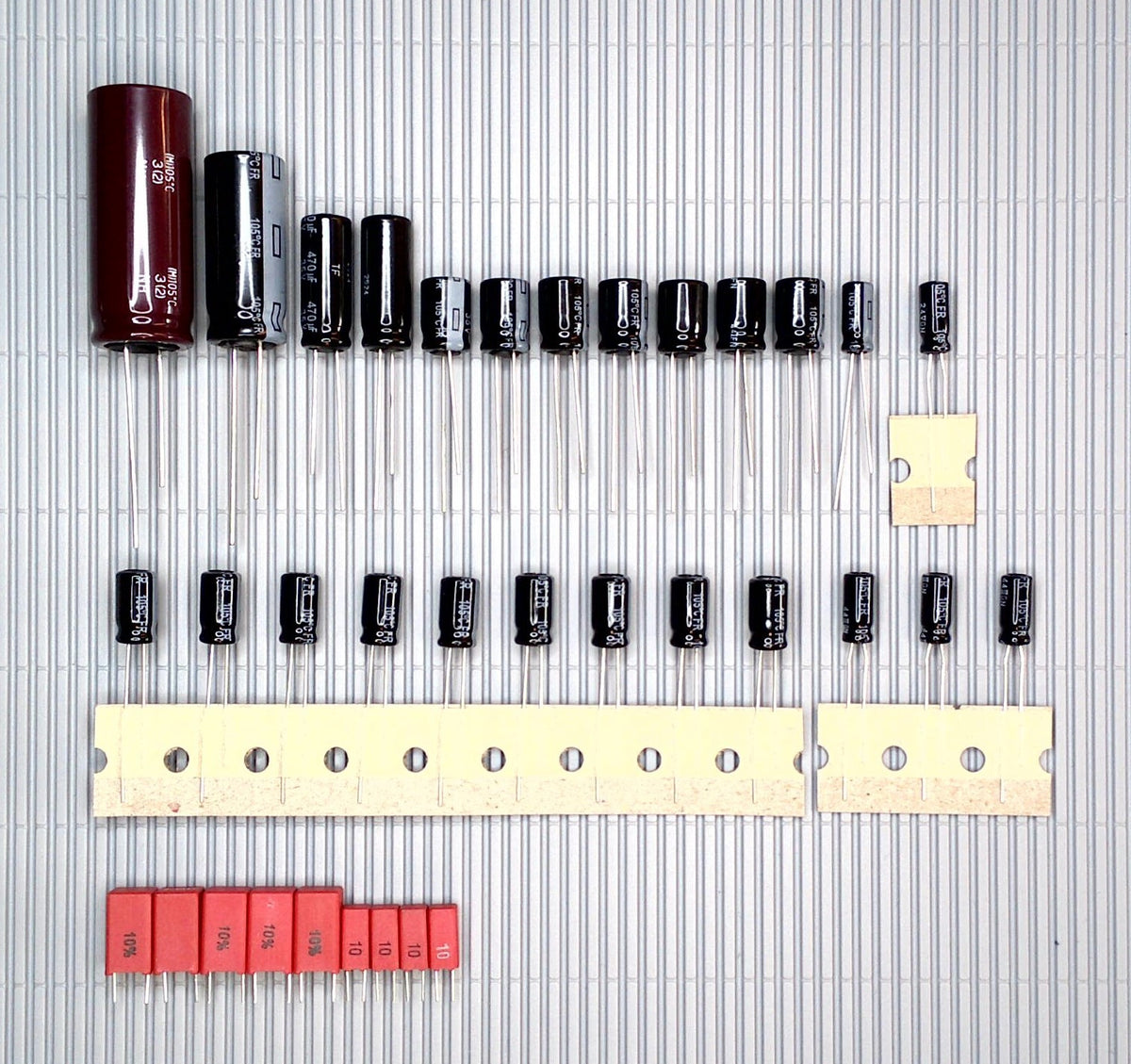
Wir bieten Ihnen jetzt den kompletten Satz, bestehend aus insgesamt 34 Kondensatoren, die in den allermeisten Fällen eine höhere Temperatur- und Spannungsfestigkeit besitzen (siehe dazu die Beschreibung unter diesem Angebot):
Panasonic-WIMA-Qualität:
Dieses Set besteht aus 24 Panasonic FR-A Kondensatoren, bekannt für ihre Audioqualität und enorme Lebensdauer, fünf WIMA MKS Folienkondensatoren für Werte unter 4,7µF (da nicht als FR-A erhältlich), ebenfalls mit hervorragender Audioqualität und nahezu unbegrenzter Lebensdauer und einem langlebigen Filterkondensator für die Stromversorgung.
Da der WIMA MKS-Folienkondensator mit dem Wert 3,3µF nicht mehr produziert wird, mussten wir dafür einen adäquaten Ersatz suchen. Gefunden haben wir diesen im Panasonic EB-A Elektrolytkondensator, der in Bezug auf die Lebensdauer und Tauglichkeit für Audio-Geräte unsere Erwartungen erfüllt (die meisten für Audio tauglichen Kondensatoren haben eine höchst unbefriedigende Lebensdauer). Dies betrifft jedoch nur den einen Wert 3,3µF, für den hier vier Ersatzkondensatoren geliefert werden. Auf dem Foto sind die nicht mehr erhältlichen Kondensatoren noch zu sehen, bis das Foto durch ein Neues ersetzt wird.
Wir bieten ein Widerrufsrecht von 60 Tagen (unbenutzte Elkos) an
General procedure for replacing capacitors
Allgemeine Vorgehensweise beim Kondensator-Tausch (siehe ganz unten)
First of all, it is advisable to take lots of photos. From the wiring, from the
circuit board, from the capacitors.
Electrolytic capacitors must be installed with the correct polarity; the
negative pole is usually marked by a strip on the side of the housing.
It's good if you can see which way around the capacitor was installed, which
you're holding between your fingers so that you can install the new one the
right way round (in some cases you can't trust printed circuit boards, if they
exist).
In individual cases, we recommend desoldering using desoldering wire and a
desoldering suction pump. An electronic desoldering station with a heated
suction gun would be best, but it is usually not worth purchasing for smaller
projects.
First get an idea of the situation. Keep in mind that in the vast majority of
cases, electrolytic capacitors were supplied with a higher voltage rating.
The value of the maximum permissible voltage (V) may be the same as that of the
old capacitor, but may very well be higher and may never be smaller.
Voltage Capability
In 1987, due to Europe-wide harmonization, the mains
voltage in some countries has been increased from 220V (198V-242V was possible)
to 230V (207V-253V is possible since then).
This may only concern Europe, but similar is possible in countries with a 100-127V
mains voltage with the same effect.
Due to the smoothening of the DC by electrolytic capacitors, which usually
takes place immediately after the transformer and rectification, and with the DC
voltage regulation only taking place afterwards, many such capacitors are now
operated above the permissible voltage. The voltage capability was usually calculated
very tightly due to the bigger size and higher price of caps with an increased
one. This is particularly noticeable in Philips CD players, where the 16V caps
in the power supply now run at 16V or above.
It is therefore strongly recommended that devices that can be switched from 220
to 240V (or from 100/110/120 one step increasing) be switched or soldered
accordingly if you live in an area such a voltage increasement has taken place.
Unfortunately, some do not offer this option; safety is then installed with an
increased voltage resistance of the electrolytic capacitors.
Capacitors have become smaller over time, so that size is no longer an
exclusion criterion for voltage capability.
An example of this:
There are four different types of 47µF capacitors installed in your device:
47µF/10V,
47µF/25V,
47µF/35V and
47µF/50V.
We would supply you with the following replacement types:
2x 47µF/35V as replacement for 10V and 25V
2x 47µF/63V as replacement for 35V and 50V
Although the original comes with a 35V capacitor, a 63V capacitor is supplied
to increase the voltage resistance.
Temperature resistance
In the past, only capacitors were installed that had a temperature resistance
of 85°C, as this corresponded to the state of electrolytic capacitor production
at the time.
Today these can easily be replaced by ones with a temperature resistance of
105°C; Unfortunately, some capacitors on the world market are sometimes only
available in 85°C versions.
A set may therefore also contain some capacitors that only have a temperature
rating of 85°C, although we try to avoid this.
Allgemeine Vorgehensweise beim Kondensator-Tausch
Zunächst ist es ratsam, viele Fotos zu machen. Von der Verkabelung, von der
Platine, von den Kondensatoren.
Elektrolytkondensatoren müssen polrichtig eingebaut werden, dafür ist bei Ihnen
in der Regel der Minus-Pol durch einen seitlichen Streifen am Gehäuse markiert.
Es ist gut, wenn man dort nachsehen kann, wie herum der Kondensator nun
eingebaut war, den man gerade zwischen den Fingern hält, um den Neuen wieder
richtig herum einbauen zu können (vereinzelt kann man auch Platinen-Aufdrucken
nicht trauen, sofern vorhanden).
Wir empfehlen im Einzelfall das Auslöten mit
Hilfe von Entlöt-Litze und einer Entlöt-Saugpumpe. Am besten wäre eine
elektronische Entlöt-Station mit beheizter Saugpistole, doch deren Anschaffung
loht sich bei kleineren Projekten meist nicht.
Verschaffen Sie sich erst ein Bild der Lage. Bedenken Sie, dass in den
allermeisten Fällen Elkos mit höherer Spannungsfestigkeit geliefert wurden.
Der Wert der maximal zulässigen Spannung (V) darf mit dem des alten
Kondensators übereinstimmen, darf aber sehr gerne höher sein und darf
niemals kleiner sein.
Spannungsfestigkeit
1987 wurde die in Europa angeglichen, dies bedeutete für manche Länder eine
Erhöhung von 220V (198V-242V waren möglich) auf ca. 230V (207V-253V sind
seitdem möglich).
In anderen Ländern mit 100-130V Netzspannung
Durch die meist sofort nach dem Transformator und der Gleichrichtung erfolgende
Siebung durch Elektrolytkondensatoren und die erst danach erfolgende
Spannungsregelung werden viele solche Kondensatoren jetzt schon über der
zulässigen Spannung betrieben, die meist wegen der Baugröße sehr knapp
berechnet waren (besonders auffällig bei Philips CD-Playern).
Deswegen wird dringend empfohlen, Geräte, die sich von 220 auf 240V umstellen
lassen, bitte entsprechend umzuschalten oder zu löten. Manche bieten diese
Möglichkeit aber leider nicht, hier wird dann mit einer erhöhten
Spannungsfestigkeit der Elkos Sicherheit eingebaut.
Kondensatoren sind im Laufe der Zeit kleiner geworden, so dass die Baugröße
kein Ausschlusskriterium mehr für höhere Spannungsfestigkeit ist.
Ein Beispiel dazu:
In Ihrem Gerät sind jeweils vier verschiedene Typen von 47µF-Kondensatoren
verbaut:
47µF/10V,
47µF/25V,
47µF/35V und
47µF/50V.
Als Ersatztypen würden Sie von uns wie folgt geliefert bekommen:
2x 47µF/35V als Ersatz für 10V und 25V
2x 47µF/63V als Ersatz für 35V und 50V
Obwohl beim Original ein 35V-Kondensator dabei ist, wird, damit die
Spannungsfestigkeit höher wird, dafür ein 63V-Kondensator geliefert.
Temperaturfestigkeit
Früher wurden nur Kondensatoren eingebaut, die eine Temperaturfestigkeit von
85°C hatten, da dies dem damaligen Stand der Elko-Fertigung entsprach.
Heute können diese einfach durch solche mit 105°C Temperaturfestigkeit ersetzt
werden; leider sind aber vereinzelte Kondensatoren auf dem Weltmarkt ab und an
nur als 85°C-Ausführung zu bekommen.
Ein Satz kann daher auch einige Kondensatoren enthalten, die nur eine
Temparaturfestigkeit von 85°C haben, auch wenn wir versuchen, das zu vermeiden.
Allgemeiner Hinweis: Es wird immer schwieriger, die kleinen Elko-Werte 0,1µF, 0,22µF, 0,33µF und 0,47µF aus aktueller Produktion zu beschaffen.
Falls Ihr gewünschtes Elko-Set diese Werte enthält, werden ab sofort dafür die sehr gut für Hifi-Anwendungen geeigneten KEMET-Folienkondensatoren der Reihe R82 beigelegt.Weiterhin werden aus dem gleichen Grund nach Verbrauch des Lagerbestands die WIMA-MKS-Folienkondensatoren mit den Werten 2,2µF und 3,3µF durch die sehr guten PANASONIC-Elektrolytkondensatoren der EB-A-Reihe ersetzt.
Marke: Bang & Olufsen
Modell: Beogram CD5500 CD6500 CD7000
Ursprungsland: Deutschland
Christoph Mistler
An der Kull 51
DE-41844 Wegberg
Email: info@80s-hifi-classics.com
Produktdokumente:
INSTALLATION_INSTRUCTIONS:
DE,EN,ES,FR,IT,NL,PL,PT.pdf
Gefahrenhinweise
Gefahrenhinweise
Informationen zur Produktsicherheit
- Bitte außerhalb der Reichweite von Kindern aufbewahren!
- Enthält Kleinteile, Erstickungsgefahr!
- Elkos enthalten möglicherweise giftiges Elektrolyt!
Vergiftungsgefahr!
- Polung muss beachtet werden!
- bei ausgestecktem Gerät und Spannungsfrei arbeiten
- Kondensatoren können auch nach längerem Nicht-Betrieb noch
lebensgefährliche Spannungen gespeichert haben!
Information on product safety
- Please keep out of the reach of children!
- Contains small parts, risk of suffocation!
- Electrolytic capacitors may contain toxic electrolyte!
Risk of poisoning!
- Polarity must be observed!
- Work with the device unplugged and de-energized
Informations sur la sécurité des produits
- Veuillez tenir hors de portée des enfants !
- Contient de petites pièces, risque d'étouffement !
- Les condensateurs électrolytiques peuvent contenir un
électrolyte toxique ! Risque d'intoxication !
- La polarité doit être respectée !
- Travaillez avec l'appareil débranché et hors tension
- Les condensateurs peuvent encore accumuler des tensions
dangereuses même après une longue période de non-utilisation !
Informazioni sulla sicurezza del prodotto
- Tenere fuori dalla portata dei bambini!
- Contiene piccole parti, rischio di soffocamento!
- I condensatori elettrolitici possono contenere elettrolita
tossico! Rischio di avvelenamento!
- È necessario rispettare la polarità!
- Lavorare con il dispositivo scollegato e senza corrente
Informatie over productveiligheid
- Buiten bereik van kinderen houden!
- Bevat kleine onderdelen, verstikkingsgevaar!
- Elektrolytische condensatoren kunnen giftige elektrolyt
bevatten! Vergiftigingsgevaar!
- Polariteit moet in acht worden genomen!
- Werk met het apparaat losgekoppeld en spanningsloos
- Condensatoren kunnen nog steeds levensbedreigende
spanningen opslaan, zelfs na een lange periode van inactiviteit!
Informacje na temat bezpieczeństwa produktu
- Przechowywać w miejscu niedostępnym dla dzieci!
- Zawiera małe części, ryzyko uduszenia!
- Kondensatory elektrolityczne mogą zawierać toksyczny
elektrolit! Ryzyko zatrucia!
- Należy przestrzegać biegunowości!
- Pracuj z urządzeniem odłączonym od zasilania i pozbawionym
zasilania
- Kondensatory mogą nadal gromadzić napięcia zagrażające
życiu nawet po długim okresie nieużywania!
Informações sobre a segurança do produto
- Por favor, mantenha fora do alcance das crianças!
- Contém peças pequenas, risco de asfixia!
- Os condensadores electrolíticos podem conter electrólito
tóxico! Risco de envenenamento!
- A polaridade deve ser observada!
- Trabalhar com o dispositivo desligado e desenergizado
- Os condensadores podem ainda armazenar tensões
potencialmente fatais mesmo após um longo período sem utilização!
Información sobre la seguridad del producto
- ¡Manténgase fuera del alcance de los niños!
- Contiene piezas pequeñas, ¡riesgo de asfixia!
- ¡Los condensadores electrolíticos pueden contener
electrolito tóxico! ¡Riesgo de intoxicación!
- ¡Se debe respetar la polaridad!
- Trabaje con el dispositivo desenchufado y sin corriente-
Los condensadores pueden seguir almacenando voltajes potencialmente mortales
incluso después de un largo período de inactividad.
Montageanleitung
Montageanleitung
Installations- und Montageanleitung
Dieser typspezifische Kondensatorsatz ist dazu gedacht, um
die im jeweiligen Gerät vorhandenen Elektrolytkondensatoren zu ersetzen; sei es
deswegen, weil die vorhandenen Kondensatoren defekt sind oder die von uns angebotenen
besser als die ursprünglich vorhandenen sind (Upgrade).
1. Zunächst ist es ratsam, viele Fotos zu machen. Von der
Verkabelung, von der Platine, von den Kondensatoren. Es ist gut, wenn man dort
nachsehen kann, wie herum der Kondensator nun eingebaut war, den man gerade
zwischen den Fingern hält, um den Neuen wieder richtig herum einbauen zu können
(vereinzelt kann man auch Platinen-Aufdrucken nicht trauen, sofern vorhanden).
2. Verschaffen Sie sich zunächst ein Bild der Lage. Bedenken
Sie, dass in den allermeisten Fällen die neuen Elkos mit höherer
Spannungsfestigkeit geliefert wurden 1.
3. Gehen Sie der Reihe nach vor, einen defekten Elko
auslöten2, einen neuen einlöten.
1 Der Wert der maximal zulässigen Spannung (V) darf mit dem
des alten Kondensators
übereinstimmen, darf aber sehr gerne höher sein und darf
niemals kleiner sein.
Ein Beispiel dazu:
In Ihrem Gerät sind jeweils vier verschiedene Typen von
47µF-Kondensatoren
verbaut:
47µF/10V, 47µF/25V,
47µF/35V und
47µF/50V.
Als Ersatztypen würden Sie von uns wie folgt geliefert
bekommen:
2x 47µF/35V als Ersatz für 10V und 25V
2x 47µF/63V als Ersatz für 35V und 50V
Obwohl beim Original ein 35V-Kondensator dabei ist, wird,
damit die
Spannungsfestigkeit höher wird, dafür ein 63V-Kondensator
geliefert.
2 Wir empfehlen im Einzelfall das Auslöten mit Hilfe von
Entlöt-Litze und einer manuellen Entlöt-Saugpumpe. Am besten wäre eine
elektronische Entlöt-Station mit beheizter Saugpistole, doch deren Anschaffung
loht sich bei kleineren Projekten meist nicht.
Installation and assembly instructions
This type-specific capacitor set is intended to replace the
electrolytic capacitors in the respective device; either because the existing
capacitors are defective or because the ones we offer are of better quality
than the original ones (upgrade).
1. First of all, it is advisable to take lots of photos. Of
the wiring, of the circuit board, of the capacitors.
Electrolytic Capacitors mostly are polarized, they have a
plus and a minus leg or side. It is good if you can look up which way the
capacitor you are holding between your fingers was installed so that the new
one can be installed the right way round (in some cases you cannot trust the
circuit board prints, if there are any).
2. Then, get an idea of the situation. Remember that in the
vast majority of cases the new capacitors were delivered with a higher voltage
resistance (see note about allowed voltage below).
3. Proceed in order: desolder an old capacitor, solder in a
new one (see note about tools for desoldering below)
Allowed Voltage: The value of the maximum permissible
voltage (V) may match that of the old capacitor, but may be higher and may
NEVER be smaller, unless the service manual of the device shows lower voltage
at that point.
An example:
Your device has four different types of 47µF capacitors
installed:
47µF/10V, 47µF/25V,
47µF/35V and
47µF/50V.
We would supply you with the following replacement types:
2x 47µF/35V as a replacement for 10V and 25V
2x 47µF/63V as a replacement for 35V and 50V
Although the original comes with a 35V capacitor and we
could supply a 35V, a 63V capacitor is supplied to increase the voltage
resistance.
Tools for desoldering: In individual cases, we recommend
desoldering using desoldering braid and a manual desoldering suction pump. The
best option would be an electronic desoldering station with a heated suction
gun, but this is usually not worth buying for smaller projects.
Instructions de montage et d'installation
Ce kit de condensateurs spécifique au type est destiné à
remplacer les condensateurs électrolytiques de l'appareil concerné ; soit parce
que les condensateurs existants sont défectueux, soit parce que ceux que nous
proposons sont de meilleure qualité que les originaux (mise à niveau).
1. Tout d'abord, il est conseillé de prendre de nombreuses
photos. Du câblage, du circuit imprimé, des condensateurs.
Les condensateurs électrolytiques sont généralement
polarisés, ils ont une patte ou un côté positif et négatif. Il est bon de
pouvoir vérifier dans quel sens le condensateur que vous tenez entre vos doigts
a été installé afin que le nouveau puisse être installé dans le bon sens (dans
certains cas, vous ne pouvez pas faire confiance aux impressions du circuit
imprimé, s'il y en a).
2. Ensuite, faites-vous une idée de la situation. N'oubliez
pas que dans la grande majorité des cas, les nouveaux condensateurs ont été
livrés avec une résistance de tension plus élevée (voir la note sur la tension
autorisée ci-dessous).
3. Procédez dans l'ordre : dessouder un ancien condensateur,
souder un nouveau (voir la remarque sur les outils de dessoudage ci-dessous)
Tension autorisée : La valeur de la tension maximale
autorisée (V) peut correspondre à celle de l'ancien condensateur, mais peut
être supérieure et ne peut JAMAIS être inférieure, sauf si le manuel
d'entretien de l'appareil indique une tension inférieure à ce stade.
Un exemple :
Votre appareil est équipé de quatre types différents de
condensateurs 47µF installés :
47µF/10 V, 47µF/25 V,
47µF/35 V et
47µF/50 V.
Nous vous proposons les types de remplacement suivants :
2x 47µF/35V en remplacement de 10V et 25V
2x 47µF/63V en remplacement de 35V et 50V
Bien que l'original soit livré avec un condensateur de 35V
et que nous puissions fournir un 35V, un condensateur de 63V est fourni pour
augmenter la résistance de tension.
Outils pour dessouder : dans certains cas, nous recommandons
de dessouder à l'aide d'une tresse à dessouder et d'une pompe d'aspiration à
dessouder manuelle. La meilleure option serait une station de dessoudage
électronique avec un pistolet d'aspiration chauffant, mais cela ne vaut
généralement pas la peine d'acheter pour les petits projets.
Istruzioni di installazione e montaggio
Questo set di condensatori specifico per tipo è destinato a
sostituire i condensatori elettrolitici nel rispettivo dispositivo; sia perché
i condensatori esistenti sono difettosi sia perché quelli che offriamo sono di
qualità migliore rispetto a quelli originali (aggiornamento).
1. Innanzitutto, è consigliabile scattare molte foto. Del
cablaggio, della scheda di circuito, dei condensatori.
I condensatori elettrolitici sono per lo più polarizzati,
hanno una gamba o un lato positivo e uno negativo. È bene se riesci a
controllare in che modo è stato installato il condensatore che tieni tra le
dita in modo che quello nuovo possa essere installato nel modo giusto (in
alcuni casi non puoi fidarti delle stampe della scheda di circuito, se ce ne
sono).
2. Quindi, fatti un'idea della situazione. Ricorda che nella
stragrande maggioranza dei casi i nuovi condensatori sono stati consegnati con
una resistenza di tensione più elevata (vedi la nota sulla tensione consentita
di seguito). 3. Procedere in ordine: dissaldare un vecchio condensatore,
saldarne uno nuovo (vedere la nota sugli strumenti per la dissaldatura di
seguito)
Tensione consentita: il valore della tensione massima
consentita (V) può corrispondere a quella del vecchio condensatore, ma può
essere superiore e NON può MAI essere inferiore, a meno che il manuale di
servizio del dispositivo non indichi una tensione inferiore in quel punto.
Un esempio:Il dispositivo ha quattro diversi tipi di
condensatori da 47µF installati:
47µF/10V, 47µF/25V,
47µF/35V e
47µF/50V.
Ti forniremo i
seguenti tipi di sostituzione:
2x 47µF/35V come sostituzione per 10V e 25V
2x 47µF/63V come sostituzione per 35V e 50V
Sebbene l'originale sia dotato di un condensatore da 35V e
potremmo fornirne uno da 35V, viene fornito un condensatore da 63V per
aumentare la resistenza di tensione.
Strumenti per la dissaldatura: in singoli casi, consigliamo
di dissaldare utilizzando una treccia dissaldante e una pompa di aspirazione
dissaldante manuale. L'opzione migliore sarebbe una stazione di dissaldatura
elettronica con una pistola di aspirazione riscaldata, ma di solito non vale la
pena acquistarla per progetti più piccoli.
Installatie- en montage-instructies
Deze typespecifieke condensatorset is bedoeld om de
elektrolytische condensatoren in het betreffende apparaat te vervangen; hetzij
omdat de bestaande condensatoren defect zijn, hetzij omdat de condensatoren die
wij aanbieden van betere kwaliteit zijn dan de originele (upgrade).
1. Allereerst is het raadzaam om veel foto's te maken. Van
de bedrading, van de printplaat, van de condensatoren.
Elektrolytische condensatoren zijn meestal gepolariseerd, ze
hebben een plus- en een minpoot of -zijde. Het is goed als u kunt opzoeken op
welke manier de condensator die u tussen uw vingers houdt was geïnstalleerd,
zodat u de nieuwe op de juiste manier kunt installeren (in sommige gevallen
kunt u de druk op de printplaten, als die er zijn, niet vertrouwen).
2. Krijg vervolgens een idee van de situatie. Vergeet niet
dat in de overgrote meerderheid van de gevallen de nieuwe condensatoren werden
geleverd met een hogere spanningsweerstand (zie opmerking over toegestane
spanning hieronder).
3. Ga in de juiste volgorde te werk: desoldeer een oude
condensator, soldeer een nieuwe (zie opmerking over gereedschappen voor
desoldeer hieronder)
Toegestane spanning: De waarde van de maximaal toegestane
spanning (V) mag overeenkomen met die van de oude condensator, maar mag hoger
zijn en mag NOOIT lager zijn, tenzij de servicehandleiding van het apparaat op
dat punt een lagere spanning aangeeft.
Een voorbeeld:
Uw apparaat heeft vier verschillende typen
47µF-condensatoren geïnstalleerd:
47µF/10V, 47µF/25V,
47µF/35V en
47µF/50V.
Wij leveren u de volgende vervangende typen:
2x 47µF/35V als vervanging voor 10V en 25V
2x 47µF/63V als vervanging voor 35V en 50V
Hoewel het origineel wordt geleverd met een 35V-condensator
en wij weer een 35V kunden leveren, wordt er een 63V-condensator meegeleverd om
de spanningsweerstand te verhogen.
Gereedschap voor het desolderen: In individuele gevallen
raden wij aan om te desolderen met behulp van desoldeerlint en een handmatige
desoldeerzuigpomp. De beste optie zou een elektronisch desoldeerstation met een
verwarmd zuigpistool zijn, maar dit is meestal te duur om te kopen voor
kleinere projecten.
Instrukcje instalacji i montażu
Ten zestaw kondensatorów specyficznych dla danego typu jest
przeznaczony do wymiany kondensatorów elektrolitycznych w danym urządzeniu;
albo dlatego, że istniejące kondensatory są wadliwe, albo dlatego, że oferowane
przez nas są lepszej jakości niż oryginalne (ulepszenie).
1. Przede wszystkim wskazane jest zrobienie wielu zdjęć.
Okablowania, płytki drukowanej, kondensatorów.
Kondensatory elektrolityczne są przeważnie spolaryzowane,
mają dodatnią i ujemną nogę lub bok. Dobrze jest sprawdzić, w którą stronę
został zainstalowany kondensator, który trzymasz między palcami, aby nowy mógł
zostać zainstalowany prawidłowo (w niektórych przypadkach nie można ufać
wydrukom płytki drukowanej, jeśli takie istnieją).
2. Następnie zapoznaj się z sytuacją. Pamiętaj, że w
zdecydowanej większości przypadków nowe kondensatory zostały dostarczone z
wyższą rezystancją napięciową (patrz uwaga dotycząca dopuszczalnego napięcia
poniżej).
3. Postępuj w kolejności: odlutuj stary kondensator, wlutuj
nowy (patrz uwaga dotycząca narzędzi do odlutowywania poniżej)
Dozwolone napięcie: Wartość maksymalnego dopuszczalnego
napięcia (V) może odpowiadać napięciu starego kondensatora, ale może być wyższa
i NIGDY nie może być mniejsza, chyba że instrukcja serwisowa urządzenia
wskazuje niższe napięcie w tym momencie.
Przykład:
W urządzeniu zainstalowano cztery różne typy kondensatorów
47µF:
47µF/10V, 47µF/25V,
47µF/35V i
47µF/50V.
Dostarczymy Ci następujące typy zamienników:
2x 47µF/35V jako zamiennik dla 10V i 25V
2x 47µF/63V jako zamiennik dla 35V i 50V
Chociaż oryginał jest wyposażony w kondensator 35V, a my
możemy dostarczyć 35V, dostarczany jest kondensator 63V w celu zwiększenia
rezystancji napięcia.
Narzędzia do odlutowywania: W indywidualnych przypadkach
zalecamy odlutowywanie za pomocą taśmy odlutowującej i ręcznej pompy ssącej do
odlutowywania. Najlepszą opcją byłaby elektroniczna stacja odlutowująca z
podgrzewanym pistoletem ssącym, ale zwykle nie warto jej kupować do mniejszych
projektów.
Instruções de instalação e montagem
Este conjunto de condensadores específico do tipo destina-se
a substituir os condensadores eletrolíticos do respetivo dispositivo; seja
porque os condensadores existentes estão avariados ou porque os que oferecemos
são de melhor qualidade que os originais (upgrade).
1.º Em primeiro lugar, é aconselhável tirar muitas
fotografias. Da cablagem, da placa de circuito, dos condensadores.
Os condensadores eletrolíticos são na sua maioria
polarizados, têm uma perna ou lado positivo e negativo. É bom se puder
verificar de que forma o condensador que está a segurar entre os dedos foi
instalado para que o novo possa ser instalado da forma correcta (em alguns
casos não pode confiar nas impressões da placa de circuito, se as houver).
2.º Depois, tenha uma ideia da situação. Recorde-se que na
grande maioria dos casos os novos condensadores foram entregues com uma
resistência de tensão mais elevada (ver nota sobre a tensão permitida abaixo).
3.º Proceda pela ordem: dessoldar um condensador antigo,
soldar um novo (ver nota sobre ferramentas para dessoldagem abaixo)
Tensão permitida: O valor da tensão máxima permitida (V)
pode corresponder ao do condensador antigo, mas pode ser superior e NUNCA
inferior, a menos que o manual de assistência do dispositivo mostre uma tensão
mais baixa nesse ponto.
Um exemplo:
O seu dispositivo possui quatro tipos diferentes de
condensadores de 47µF instalados:
47µF/10V, 47µF/25V,
47µF/35V e
47µF/50V.
Forneceremos os seguintes tipos de substituição:
2x 47µF/35V em substituição de 10V e 25V
2x 47µF/63V em substituição de 35V e 50V
Embora o original venha com um condensador de 35 V e
possamos fornecer 35 V, é fornecido um condensador de 63 V para aumentar a
resistência da tensão.
Ferramentas para dessoldagem: Em casos individuais,
recomendamos a dessoldagem utilizando uma trança de dessoldagem e uma bomba de
sucção de dessoldagem manual. A melhor opção seria uma estação de dessoldagem
eletrónica com pistola de aspiração aquecida, mas geralmente não vale a pena
comprar para projetos mais pequenos.
Instrucciones de instalación y montaje
Este juego de condensadores específicos para cada tipo está
pensado para sustituir los condensadores electrolíticos del dispositivo
correspondiente, ya sea porque los condensadores existentes están defectuosos o
porque los que ofrecemos son de mejor calidad que los originales
(actualización).
1. En primer lugar, es recomendable tomar muchas
fotografías. Del cableado, de la placa de circuitos, de los condensadores.
Los condensadores electrolíticos en su mayoría están
polarizados, tienen un lado positivo y otro negativo. Es bueno que puedas
buscar en qué dirección se instaló el condensador que tienes entre los dedos
para poder instalar el nuevo en la dirección correcta (en algunos casos no
puedes confiar en las impresiones de la placa de circuitos, si las hay).
2. A continuación, hazte una idea de la situación. Recuerda
que en la gran mayoría de los casos los condensadores nuevos se entregaron con
una resistencia de voltaje más alta (ver nota sobre el voltaje permitido a
continuación).
3. Proceda en orden: desuelde un condensador viejo, suelde
uno nuevo (consulte la nota sobre las herramientas para desoldar a
continuación)
Voltaje permitido: el valor del voltaje máximo permitido (V)
puede coincidir con el del condensador viejo, pero puede ser mayor y NUNCA
menor, a menos que el manual de servicio del dispositivo muestre un voltaje
menor en ese punto.
Un ejemplo:
Su dispositivo tiene instalados cuatro tipos diferentes de
condensadores de 47 µF:
47 µF/10 V, 47 µF/25 V,
47 µF/35 V y
47 µF/50 V.
Le suministraremos los siguientes tipos de repuesto:
2x 47µF/35V como reemplazo para 10V y 25V
2x 47µF/63V como reemplazo para 35V y 50V
Aunque el original viene con un condensador de 35V y
podríamos suministrar uno de 35V, se suministra un condensador de 63V para
aumentar la resistencia de voltaje.
Herramientas para desoldar: En casos individuales,
recomendamos desoldar utilizando una malla desoldadora y una bomba de succión
manual para desoldar. La mejor opción sería una estación de desoldar
electrónica con una pistola de succión calentada, pero por lo general no vale
la pena comprarla para proyectos más pequeños.
Hersteller
Hersteller
Bang & Olufsen
Share